

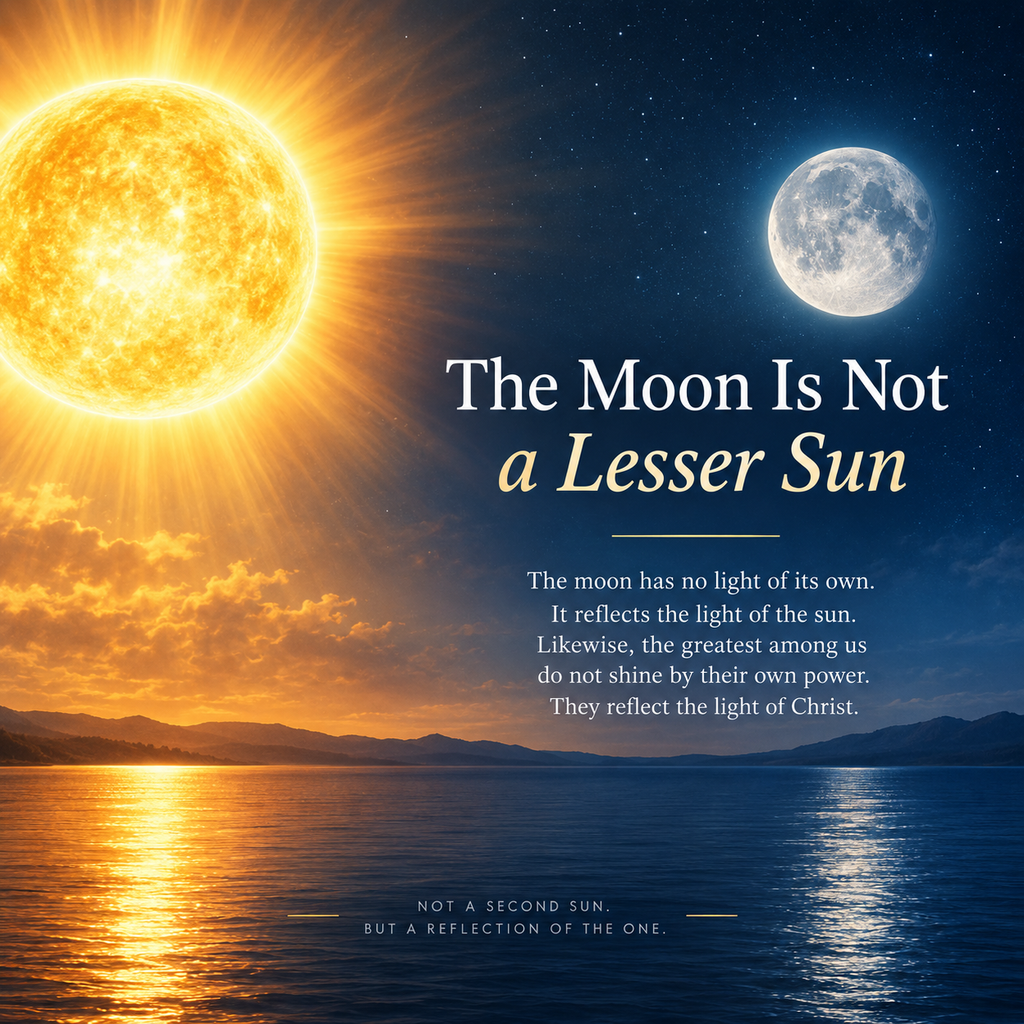
What would you say if someone praised the moon as the second brightest object in the sky that does more to provide the earth with light than any celestial object other than the sun? You might respond by noting three facts: First of all, the sun’s brightness, luster, and glory is immeasurably greater than the moon’s. Second, any light that the moon radiates is not its own, but wholly derivative of and reflecting the sun’s light. Third, the Sun does for us what the moon by its nature cannot do, it originates and provides us with light. So whether it is technically true or not, the very comparison is diminishing and nonsensical.
This analogy makes me think of a comparison that is made in the Doctrine and Covenants between Joseph Smith and Jesus: “Joseph Smith, the Prophet and Seer of the Lord, has done more, save Jesus only, for the salvation of men in this world, than any other man that ever lived in it.” (D&C 135:3). This verse was written shortly after the death of Joseph Smith and so its degree of hyperbole is understandable. Yet this verse is canonized as inspired scripture in the LDS canon giving it an appearance of divine approval.
And yet, just as the comparison between the radiance of the moon and the sun diminishes the greatness of the sun, the same is true for the attempt to compare the impact and accomplishment of Jesus Christ and any mortal man like Joseph Smith.
First of all, Jesus’s impact is inestimably more than any human impact.
This is the repeated point of the Book of Hebrews. In the past, God spoke through many prophets, but God spoke climactically and triumphantly through his Son. (Hebrews 1:1). Moses was a faithful servant in God’s house. But Christ “is faithful as the Son over God’s house” and is “found worthy of greater honor than Moses.” (Hebrews 3:1-6). Biblical priests like Aaron were chosen by God, (Hebrews 5:4), but Jesus alone was called “a priest forever in the order of Melchizedek” and “became the eternal salvation for all who obey him.” Hebrews 5:6, 9).
The Bible points to Jesus as the culmination of all of its promises. Jesus is the sinless human representative that Adam was not. He is our blameless Passover lamb. He is our perfect prophet, our glorious king, and our spotless eternal priest.
Second, any light that human beings reflect is only derivative and a reflection of his light.
The first chapter of John’s Gospel makes this point clearly. John emphasizes that Jesus was “the true light that gives light to everyone.” By contrast, John the Baptist “was not the light; he came only as a witness to the light.” John testifies that even though Jesus would come after him, he was greater than John because “he was before me.” Indeed, Jesus was so much greater that John exclaimed that he was not worthy to untie the straps of Jesus’s sandals, a lowly servant’s task. John understood that there was simply no comparison between him and Jesus. John was a “burning and shining lamp.” John 5:35. But Jesus was the light that gives light to the world.
Ultimately the moon is not a lesser sun; it is an object that reflects the glory of the sun. Likewise, Jesus isn’t just a greater prophet than Moses (or Joseph Smith), he is the very reason that any Prophet was a prophet at all.
Third, what Jesus does is beyond any calculation or comparison to our contribution
Making the comparison between Jesus and Joseph Smith that D&C 135:3 makes suggests that their contributions can be measured and compared in some way like units on a scale. But Jesus is the one who establishes the scale and causes it to exist at all.
Furthermore, what Jesus did is of infinite and eternal worth. However much we have accomplished relative to each other is meaningless in comparison to infinity. Calling Joseph Smith, the person who did the second most for the salvation of mankind therefore misses the point altogether. Whether one person has done more, less, or vastly more than another, both are finite in comparison to infinity.
Just as the moon cannot be ranked as a second sun, Christ’s followers cannot be ranked and compared with Christ. Indeed, the very attempt to construct such a ranking diminishes Christ and elevates our contributions. We should instead recognize with awe and gratitude that the work of Christ is infinitely greater than anything we can imagine and that our contributions all depend fully on him in the first place.