In the last few days, I’ve seen several Latter-day Saints promoting a study that claims to provide “a neutral, text-driven framework” for evaluating which Church is most consistent with the Bible. The study assigns an objective “Bible Score” to 12 different faith traditions and concludes that the LDS Church “reproduces more biblical patterns” than all the rest.
But does this study actually deliver on that promise?
The answer is no.
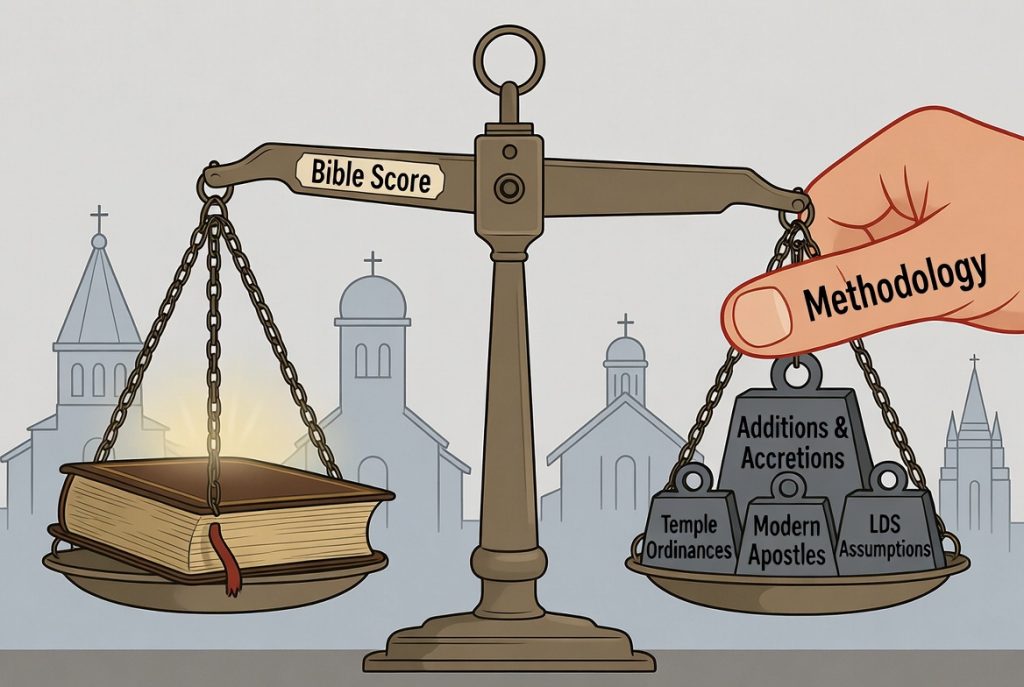
When you examine the methodology and framework, it becomes clear that the system is not neutral. It is structurally designed in a way that places its thumb on the scale in favor of the LDS Church. Its conclusions are not the result of objective measurement, but of the assumptions built into the model itself.
Here are five major problems.
1) The methodology rewards doctrinal expansion and penalizes restraint
One of the most fundamental flaws is the system’s asymmetric treatment of additions/accretions and omissions. This is not accidental In fact, the study’s “single foundational principle” according to the authors, is this: “the Bible is the floor, not the ceiling.” Indeed, they go even further in stating that: “The most serious error isn’t what you add. It’s what you remove.”
The way this works in practice is that
- Churches are heavily penalized for not having certain features
- But they are only lightly penalized for adding doctrines or practices
This creates a built-in bias:
The more theological categories, offices, rituals, and structures a church accumulates, the higher it can score
On the other hand, traditions that intentionally limit themselves to what they believe is clearly taught in the New Testament are disadvantaged.
The result is that the study systemically favors churches like the LDS Church, Oriental Orthodoxy, Catholicism, and Eastern Orthodoxy that are known for additions and accretions. By contrast, traditions that intentionally limit themselves to what they believe Scripture clearly teaches are penalized for that restraint.
This assumption is not neutral—and it is difficult to square with the New Testament. In Galatians, Paul warns that those who add circumcision to the gospel are “severed from Christ” and “fallen away from grace” (Galatians 5:4). Even small additions are treated as dangerous: “A little leaven leavens the whole lump” (Galatians 5:9).
A truly biblical methodology would take additions and subtractions equally seriously. This one does not.
2. The study relies on shallow parallelism instead of real theological comparison
The model frequently treats surface-level similarities as evidence of alignment without asking whether those similarities are meaningful.
For instance, the survey credits the LDS Church for having modern temple ordinances because Old Testament temples existed. But it does not ask whether these parallels are more than surface deep and whether the ordinances performed in LDS temples resembles those performed anciently. The survey therefore finds alignment based on superficial connections rather than true parallels.
Even more problematically, the survey fails to ask how these Old Testament institutions are to be understood in light of Christ and his new covenant. The survey therefore assumes that Old Testament rules and institutions like the Temple or the Aaronic Priesthood continue even though many Christians believe that those institutions served as types and shadows that are fulfilled and transformed in Christ.
The same problem shows up with regard to the study’s analysis of church officers. Because a church uses labels like “apostles,” “teachers,” or “deacons” (cf. Ephesians 4), it can receive full credit—even when those offices differ dramatically in function, authority, and qualification.
In the LDS case, this includes offices like “patriarch” with no clear New Testament analogue, and roles like teachers and deacons being held by teenagers, which departs significantly from the pastoral qualifications described in the New Testament.
Nevertheless, the LDS Church gets full credit for having officers who superficially use the same titles used in the Bible.
In short, the system measures terminological overlap, not functional or theological equivalence. This is a major flaw.
3. The Survey embeds LDS specific assumptions as if they were universal standard
The survey also assumes that LDS doctrines are core and universal standards and evaluates other churches based on their adherence to these standards.
For instance, the survey assumes that temple theology should be central to Christ’s church, and that both the Aaronic and Melchizedek priesthoods should be distinguished and operational in the Church. But no other Church believes in the ongoing work of the Aaronic Priesthood given that this priesthood was limited to Israel and made obsolete in Christ (See Hebrews 7:18-28). And the idea of an ongoing, institutional “Melchizedek priesthood” is at best a debated interpretation—not a clear, universally recognized biblical teaching that can serve as a measuring rod for orthodoxy. But the study nevertheless penalizes churches based on the fact that the “Melchizedek priesthood [is] not engaged.”
This is simply question begging. if you assume that LDS teachings are true, then it’s not surprising that Churches that do not teach those things are going to be penalized. But that says more about the study’s author and the study’s design than anything about Biblical truth.
When such assumptions are built into the scoring system, the model is no longer evaluating traditions against the Bible alone. It is evaluating them against a preloaded theological framework—one that already aligns closely with LDS categories.
4. The survey inconsistently applies its own standards
Even when the study applies the same category to different churches, the criteria for each category shift depending on the tradition being evaluated
For instance, the study gives a score for “Transparency”
When evaluating the LDS Church, the study looks at factors like access to texts and institutional openness to scholarly research. Because of recent advances such as the Joseph Smith papers, the LDS Church gets high marks in this category.
On the other hand, when evaluating Pentecostalism, the survey looks at epistemology and critiques the Pentecostal church for having a spirit-led epistemology and tolerating inaccurate prophecies.
These are not equivalent standards. One measures information access, the other measures epistemology and prophetic reliability.
When the study compares apples to oranges, it is very difficult to take the numbers that it assigns to various churches as anything other than subjective judgment.
The survey also selectively penalizes churches for the same flaws. For instance, the Eastern Orthodox church is penalized because it teaches that “salvation requires ordained clergy-administered sacraments,” and yet the LDS Church is not penalized for a similar issue even though the D&C declares baptism without proper LDS priesthood authority to be a dead work and unacceptable to God.
Because the survey did not accurately define or equally apply categories, its measurements cannot be taken as objective.
5. The canon chosen does not consistently affect the results
One of the study’s most unique features is that it purports to take into account different canons. Each church was evaluated based on a 66 book protestant canon, a 73-book Catholic canon, and 81-book Oriental Orthodox Canon, the tradition’s own canon, and a “union baseline” that purportedly harmonizes the data.
I can’t tell exactly what the study did wrong here, but it is clear that this aspect of the study is not operating as the authors intended it to.
One obvious indicator of this is that the LDS Church allegedly scores the same score when a 66-book canon is used and when the Church’s “own canon” the “66-Book Bible + LDS Standard Works” is used. That obviously can’t be true given that LDS scripture clearly provides support for many LDS doctrines that are not supported by the Bible. The most likely explanation is that the study just used the 66-book Biblical canon for evaluating the LDS Church’s own canon. But the study’s description of LDS Church’s own canon suggests otherwise, so something isn’t lining up here.
This problem appears to be pervasive. Calvinism for instance receives the exact same score regardless of the model used. In fact that is true for all of the churches other than Eastern and Oriental Orthodoxy, Catholicism, and the LDS Church who receive higher scores under larger canons.
This also strongly reinforces my earlier conclusion that the canon is not functioning as a real constraint on the model. Rather than determining the outcome, the canon simply provides a larger or smaller pool of material from which parallels can be drawn. Larger canons inflate scores of Churches like the LDS Church by increasing the number of possible connections and parallels.
Another more serious problem is that the model claims to evaluate traditions according to their own canon, but in practice, it penalizes churches for not engaging themes that go beyond their canon or beyond standard interpretations of it. Pentecostalism, for instance, is marked down for not emphasizing concepts like premortal existence or expanded temple theology—ideas that are neither explicit nor widely accepted within the 66-book canon. And Calvinism is similarly marked down because “Broader canonical material [is] absent.” But once again, that’s just question begging and assuming the LDS worldview is correct.
Conclusion
Taken together, these flaws fatally undermine any reliability this Bible Score methodology has.
The system does not function as a neutral evaluation of biblical fidelity. It functions as a structured comparison of traditions against a preselected theological framework that is modeled after and systematically favors the LDS Church.
It rewards expansion over restraint, surface resemblance over theological substance, and alignment with its own assumptions over alignment with the text itself. Its categories shift, its scoring is opaque, and even the canon method it claims to use has an inconsistent impact on the scores and is applied unevenly.
At that point, the outcome is no longer surprising.
The model does not tell us which churches best align with Scripture. It tells us which churches best align with the model and its LDS-centric assumptions