

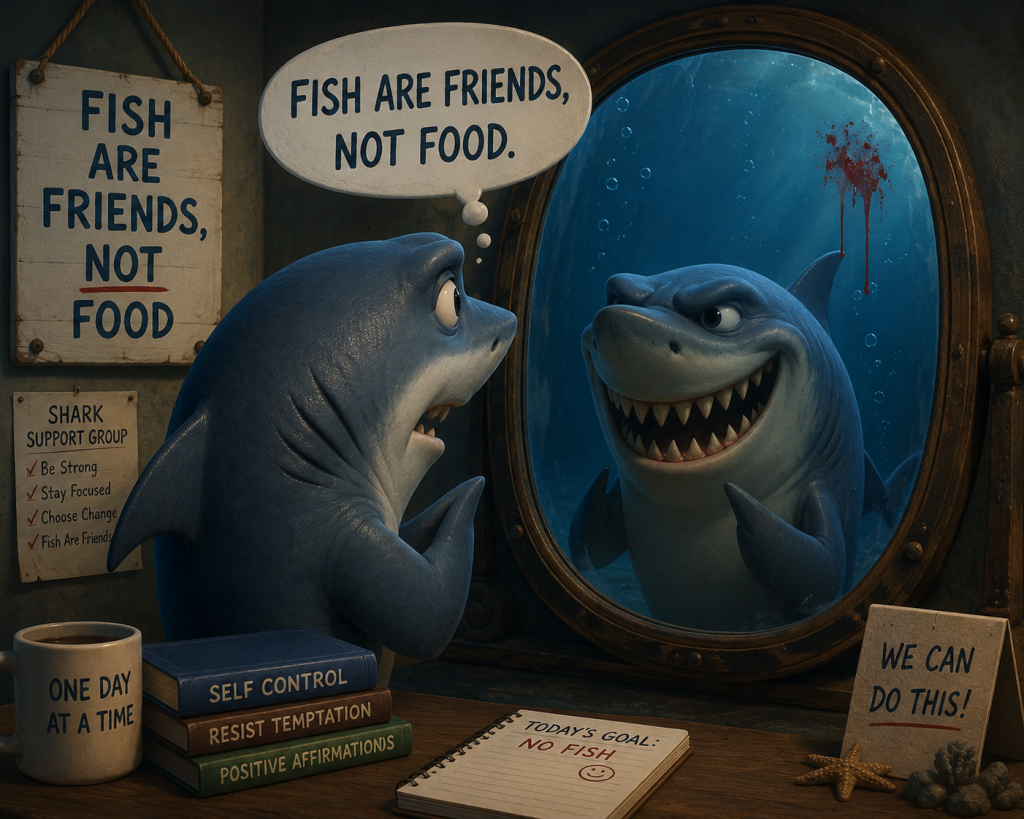
My youngest daughter recently performed in a theater camp production of Finding Nemo Jr. It was a delightful show that reminded me how much I’ve always loved the movie. One of my favorite scenes, both in the film and on stage, is the encounter between Marlin, Dory, and the sharks who are trying to become vegetarians.
The sharks gather for meetings, encourage one another, and repeat their slogan: “Fish are friends, not food.” They are genuinely trying not to eat fish. Yet their nature has not been changed. So when Bruce catches the scent of a drop of blood, all of his good intentions disappear. He responds according to his nature. He is overcome by his appetite and pursues Dory as sharks do.
Watching that scene made me think about what Scripture teaches regarding our fallen human nature. In many ways, the sharks provide a helpful illustration of what Protestants mean by the doctrine of total depravity.
Total depravity is often misunderstood. It does not mean that every person is as evil as he could possibly be. Many unbelievers. perform acts of kindness, demonstrate self-control, and are loving spouses, parents, friends, and neighbors. They live outwardly respectable and moral lives.
Rather, total depravity means that the fall has affected every aspect of our being. Sin is not just what we do, but something that comes from our corrupted nature. Scripture describes humanity after the fall as having hearts inclined toward evil. Paul’s indictment in Romans 3 is sweeping: “None is righteous, no, not one.” Sin has touched our minds, our wills, our words, our desires, and our affections.
The prophet Jeremiah makes a similar point:
“Can the Ethiopian change his skin or the leopard his spots? Then also you can do good who are accustomed to do evil” (Jeremiah 13:23).
Jeremiah’s point is not that unbelievers are incapable of outwardly good act. Instead, he is describing the impossibility of self-transformation. A leopard cannot simply decide to remove its spots, just as a shark cannot eliminate his craving for flesh. In the same way, fallen humanity cannot cure its own sin problem through moral effort alone.
That is what makes the sharks such a fitting illustration. They know what is right. They attend the meetings. They repeat the slogan. They sincerely want to improve. Yet Bruce cannot stop being a shark simply by trying harder. His nature remains unchanged.
Likewise, we can recognize what is right. We can repeat moral slogans, find upstanding communities, and strive to become better people. Yet none of those things can change the heart. The problem runs deeper than behavior.
That is why the gospel offers something far greater than moral improvement: an inside-out transformation. The same prophet who diagnosed the problem also pointed to the solution. Jeremiah foretold a day when God would establish a new covenant and write His law upon the hearts of His people. (Jeremiah 31)
Through Christ, that promise becomes reality. God gives us a new heart and puts His Spirit within us. He changes our desires so that we increasingly love what He loves and hate what He hates.
This transformation does not happen all at once. Christians still struggle with sin. We continue to wrestle with the remnants of our old nature and the desires of the flesh. Sanctification is a lifelong process. Yet God is at work within us, gradually reshaping our affections, desires, passions, and appetites.
The sharks’ problem was not a lack of information. They knew the slogan. It wasn’t a lack of effort. They attended the meetings. Their problem was that they were still sharks.
In the same way, our deepest problem is not a lack of moral instruction, more effort, or a better support network. We need more than better habits, stronger willpower, or inspiring aphorisms. We need a new heart. And that is precisely what Jesus Christ came to give us.