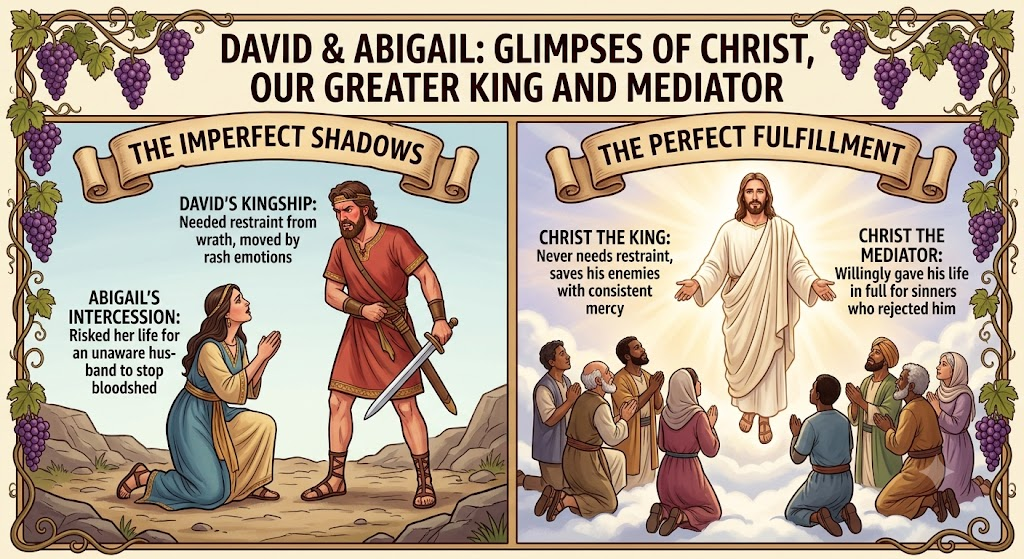

One of the most relatable moments in the life of David is the story of David, Nabal, and Abigail. It is a moment where David is treated badly and responds with anger rather than restraint. In fact, Davis is about to respond with violence and kill not only the man who insulted him, but all of the men of his household. But fortunately, Nabal’s wife, Abigail, intervenes and intercedes on her husband’s behalf.
I was reminded of this story in a great sermon in Church today that caused me to reflect on both the human aspects of this story and how it points us to worship our great king and mediator, Jesus Christ:
David’s Forgiveness and Abigail’s Intervention
On one level, I love this story because of its human elements. At other moments in his life, David had shown remarkable restraint. In fact, just a few chapters earlier, David had spared the life of Saul even though Saul had been pursuing David to kill him and even though Saul had fallen right into David’s hands. Yet, in this moment, David loses his cool and is filled with anger. When Abigail comes to him, David is swearing in the name of God that he will take vengeance: “May God deal with David, be it ever so severely, if by morning I leave alive one male of all who belong to him!” Not David’s finest moment to be sure, and yet it is part of what makes David’s life and story so enduring.
I also love Abigail’s boldness and willingness to intercede. She potentially risks her own life by meeting David. And she appeals to him on both by recognizing his status as one called of God to lead and by appealing to his better nature: “When the Lord has fulfilled for my lord every good thing he promised concerning him and has appointed him ruler over Israel, my lord will not have on his conscience the staggering burden of needless bloodshed or of having avenged himself.”
I also love seeing that this event seems to have changed David’s heart in lasting ways. David responded with deep humility and recognition of the mistake he was going to make. He accepts fault when it would have been so easy to rationalize and justify his anger. And he recognizes that Abigail spoke a message from God for David: “David said to Abigail, “Praise be to the Lord, the God of Israel, who has sent you today to meet me.May you be blessed for your good judgment and for keeping me from bloodshed this day and from avenging myself with my own hands.”
Years later, when David faces a similar insult while on the run from his son, his response seems to have been shaped by Abigail’s wisdom. When David’s men want to kill a man who curses David, he urges restraint: “Leave him alone; let him curse, for the Lord has told him to. It may be that the Lord will look upon my misery and restore to me his covenant blessing instead of his curse today.” David seems to have learned and grown from his earlier mistakes, and I find that example encouraging and hopeful.
A Double Type of Christ
On another level, this story represents a beautiful double picture of Christ. Abigail points us to Christ the Mediator, who intercedes on behalf of the guilty. David points us to Christ the King, who has the authority to judge yet chooses to extend mercy. But the comparison also reveals how much greater Jesus is than either of them.
Christ the Mediator
And yet Abigail’s example also exposes for us how much better our Savior is. Abigail intercedes without her husband knowing. But Jesus intercedes for us even though we were “yet sinners” who rejected him and even crucified him. Abigail offers her life but is not required to pay with it. Jesus likewise offered his life for ours, but willingly gave it in full for us. Abigail risked her life to intercede for her guilty husband. But Jesus gave his life to intercede for guilty sinners who had rejected him.
Christ the King
David, meanwhile, points us to the superiority of Christ’s kingship. David was a king who needed Abigail to restrain him from vengeance. But Jesus is the King who came to save even his enemies. David received a message from God through Abigail that turned David away from wrath and vengeance. But in Christ, God himself enters the story to accomplish mercy for his people because of his overflowing love and mercy for us. David had moments of great mercy. But Jesus’s every action perfectly reflects the mercy and love of God.
The Consistency of God’s Mercy
This story highlights one aspect of God’s character in particular: his consistency.
One of the defining flaws of David, revealed through this story and other moments in his life, is that he can respond to situations based on his own emotions and wounds. His mercy, though real, is imperfect and inconsistent. Saul receives grace when David is at his best, while Nabal nearly receives destruction when David is at his worst. Shimei is spared when David has learned restraint, yet David still carries unresolved bitterness and leaves instructions to Solomon to deal with him after his death. David’s mercy is genuine, but it is the mercy of a sinful and finite man.
How grateful I am that our God is not like that. God does not act impulsively or rashly. And rather than seek immediate justice, he defers the judgment we deserve and patiently calls us to repent.
When God revealed himself to Moses, he did not describe himself as unpredictable or easily provoked. He declared: “The LORD, the LORD, a God merciful and gracious, slow to anger, and abounding in steadfast love and faithfulness, keeping steadfast love for thousands…” (Exodus 34:6-7).
God’s mercy is not a temporary disposition or a passing emotion. It flows from his eternal character. Unlike David, who could forgive one person and hold a grudge against another, God does not show favoritism or act according to changing circumstances. He is faithful in his justice and faithful in his mercy.
God’s consistency, stemming from his nature and character rather than circumstances, is what theologians call God’s impassibility. This is a beautiful and often misunderstood doctrine. Properly understood, it does not mean God is cold or unmoved. It does not mean that God lacks love, compassion, or delight. Rather, it means his character is not unstable or dependent upon circumstances outside himself. His love is not something that comes and goes. His mercy is not something that must be awakened. It is who he eternally is.
God’s impassibility is what makes God so much more reliable and dependable than King David.
When God forgives our sins, he does not forgive reluctantly or temporarily. He does not keep a record of wrongs waiting to bring them up again. He promises that he will cast our sins “as far as the east is from the west” and remember them no more. Unlike David, who carried unresolved grievances even to his deathbed, God does not hold our sins over us after he has forgiven us. We can fully trust in him and his word.
Conclusion
Ultimately, Abigail and David point us to worship our good and gracious God. In Christ, God reveals himself as the righteous King who never does injustice and the gracious Mediator who sacrifices himself on behalf of his people.
As Paul explained, “God was in Christ reconciling the world to himself, not counting their trespasses against them” (2 Corinthians 5:19). Praise God for our greater king and our greater mediator!