

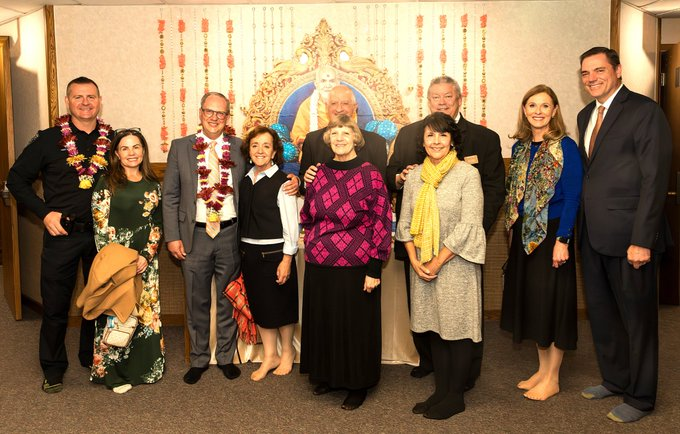
At the end of November, the LDS Newsroom announced that the Church had given a $50,000 dollar donation to a BAPS, a Hindu denomination, to support their opening of a temple in Kearns Utah. LDS Church leaders spoke and “expressed continued support for the Hindu faith.”
Leaders posed for pictures in front of an altar for the BAPS leader. BAPS members consider this leader to be a guru, a perfect devotee of the God Akshar, and one whom Akshar resides in.
The previous day the LDS newsroom also posted pictures of a visit LDS Apostle David A. Bednar made to the United Arab Emirates to meet with the local leader of the BAPS faith, His Holiness Brahmavihari Swamiji.

In the news release about Elder Bednar’s visit, Elder Parrella, First Counselor in the Middle East/Africa North Area Presidency, noted how he had been impressed by the Hindu temple “not only by the architecture but by the devotion of the people” and that he was “honored to call these people my brothers and sisters.”
A few years ago, when I was LDS I would have enthusiastically welcomed these interfaith efforts. But now I am deeply disturbed that a Church that claims to be Christian (and indeed claims to be Christ’s church) would donate money to the building of a Hindu house of worship.
To be clear, supporting disaster relief or other community programs alongside people of other faiths is a good and natural expression of neighbor-love. But what the LDS Church did with actually donating to the opening of a Hindu temple crosses the line.
1) False Faiths and Traditions Are Not From God
A Hindu temple is a place devoted to the worship of “gods that are no gods” (Jer. 2:11), “the work of men’s hands” (Ps. 115:4), and “demons and not God” (Deut. 32:17; 1 Cor. 10:20). At best, these so-called divine beings are non-existent and powerless. At worst, they are actually demonic forces. Either way, these beings that are worshiped in Hindu temples are “by their nature not god” (Galatians 4:8).
The Bible warns the people of Israel against any entanglement with Pagan worship practices. For instance, Deuteronomy 7 commands that images of the Canaanite gods should be burned and that the people should not even allow them inside their house. These things are “detestable to the LORD” and his people are warned that if they tolerate these things, they will be “ensnared” and ultimately destroyed.
Too many of my LDS friends seem to take these warnings far too casually. Christians cannot do so. They cannot pretend that encouraging the worship of other gods is merely harmless or just one acceptable and even praiseworthy choice among many.
2) Faith in false gods is not a Biblical virtue
LDS leaders today seem to see faith in any God or Gods as a good thing that deserves praise, celebration, and even financial support.
In doing so, LDS leaders are adopting a post-modernist approach to faith, which has no Biblical foundation. In his wonderful book Biblical Critical Theory, Christopher Watkin describes the adoption of terms like “people of faith” and “faith communities” as generic terms to cover “the Abrahamic faiths, Hinduism, Buddhism, and any number of smaller sects” and how this development represents a shift away from focusing on and assessing the truth claims of these faiths
In contrast to this post-modern trend towards generically praising or criticizing “people of faith” or faith as a whole, the Bible never praises the sincere faith that people have in false Gods. For instance, it is clear that the devotees of Baal have a passionate belief in Baal, but Elijah nevertheless mocks them and God ultimately destroys them.
The Bible also never treats false religious practices as “better than nothing” or things to be tolerated (Deut 12:2–4; Ex 23:24). To the contrary, those kings and religious leaders who took a strong stance against worship of false gods like Baal and Asherah are those who are praised—such as Hezekiah (2 Kgs 18:3–6), Asa (1 Kgs 15:11–13), and especially Josiah (2 Kgs 23:4–7, 19–25)—while those who took a more hands-off approach are condemned for failing to tear down the “high places” of false worship (2 Kgs 12:2–3; 14:3–4; 15:3–4; 15:34–35).
The closest that we get to a positive comment about Pagan believers is when Paul preaches to the men of Athens. He notes that they are “very religious,” which is why they have an altar of worship to the unknown God. But Paul does not simply praise their devotion to the Greek pantheon. Instead, he proclaims to them the truth about “The God who made the world and everything in it.” (Acts 17:24) He declares that God will no longer overlook their ignorance and commands them to repent in the name of Jesus Christ. (Acts 17:30).
Or take Jesus’s encounter with the woman at the well. When the woman mentions that her people worship on Mount Gerazim rather than Jerusalem, Jesus did not try to tell her that her worship at the false temples was pleasing to God. Instead, he declares: “You worship what you do not know; we worship what we do know, for salvation is from the Jews.” John 4:22. Jesus never encouraged false beliefs or false worship.
3) Tolerance does not equate to financial support
None of this means that modern-day Christians need to tear down or attack the worship of non-Christians. Religious liberty, even for those who believe very differently from us, is fertile soil that allows the truth of the Gospel to spread. And we can and should partner together to build stronger communities and support common causes.
But we do not advance the cause of Christ by blurring the lines between truth and falsehood and affirming the worship of other gods. The apostles did not do this. The prophets did not do this. Jesus Himself did not do this. They proclaimed boldly and fearlessly that there was “there is one God, and there is one mediator between God and men, the man Christ Jesus” (1 Tim. 2:5).
A church that can donate money to the construction of a Hindu temple, praise the devotion shown there, and pose before altars dedicated to false spiritual powers is operating with a fundamentally different understanding of God, worship, and truth than Christ and the early Christians did.