I was studying some of the history in Kings and Chronicles today, especially in 2 Chronicles while listening to a sermon series that a local church has been doing on the Kings of Judah. There are some really fascinating and powerful stories here. It’s a section of the Bible I’ve neglected and that truthfully doesn’t get a lot of attention. But it is crucial for biblical theology because these books—from Solomon’s reign all the way to the exile—ultimately wrestle with the question: Will God be faithful to His promises to David?
David had been promised that one of his descendants would reign over the kingdom forever. Yet from Rehoboam onward, we find division, dissension, war, and the people of Israel and Judah repeatedly turning to false gods. In Judah, there are cycles of good kings and wicked kings. Some are mostly good but flawed. Some are mostly wicked. Others begin wickedly and later repent. Throughout it all, the question remains: What will happen to God’s promise?
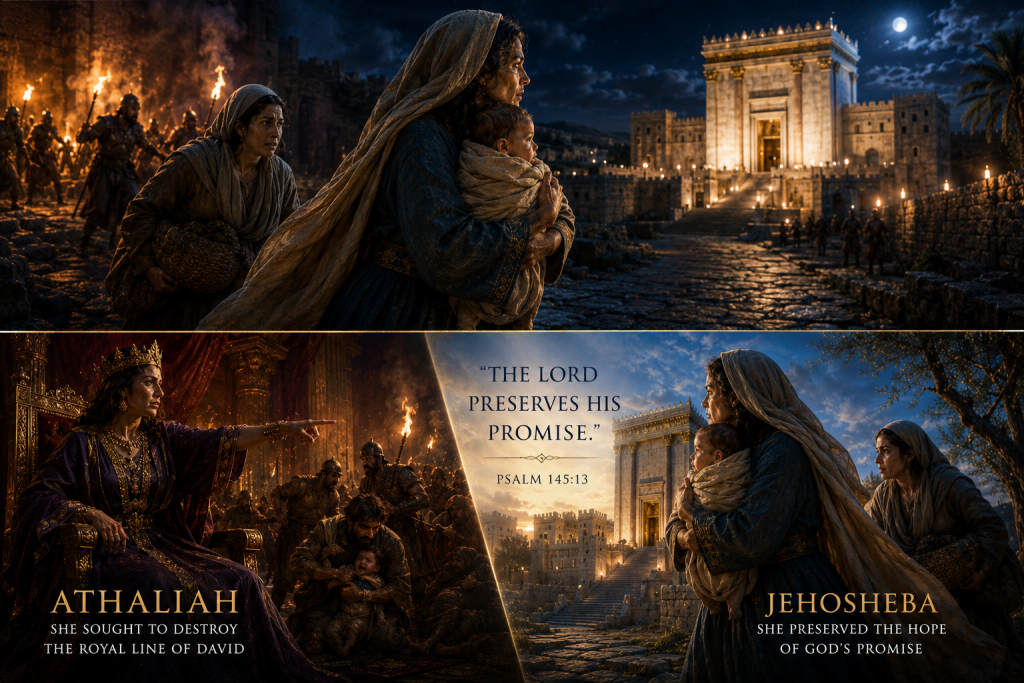
One story that particularly stood out to me is that of Athaliah, the only queen to rule Judah.
She was the mother of King Ahaziah. Ahaziah was wicked, and his family had been corrupted through alliances with the kings of Israel. They had turned to idol worship and pursued great wickedness.
Ahaziah died under unusual circumstances, and when Athaliah saw that her son was dead, she moved to destroy the entire royal family of Judah. She murdered members of her own family in an attempt to eliminate every possible rival to the throne.
For a moment, it appears that the whole line of David has been wiped out and that all hope is extinguished. God’s promise to David appears to have failed. God’s hope for the world, His plan of redemption, seems as though it will never come to pass. If the Davidic line is gone, then the promised King will never be born. From a human perspective, all is lost.
But God, in His providence, had prepared a way to preserve the Davidic line and, with it, His promises to us.
We then read that Jehosheba, the daughter of King Jehoram, took Joash, the son of Ahaziah, and stole him away from among the royal princes who were about to be murdered. She hid him and his nurse in the temple of God, where he remained concealed for six years while Athaliah ruled the land.
Eventually, the righteous priest Jehoiada orchestrated a coup to restore the rightful king to the throne. It is a moment of tremendous joy and covenant renewal. The people make a covenant to be God’s people once again. They tear down the altars and images of Baal. The false priest is executed. The temple is restored. The Davidic king is back on the throne.
It is a beautiful moment of hope.
Yet we know from the larger story that this hope will not last. Jehoiada is not the ultimate priest. He will die, and his influence will fade. After his death, Joash is led astray. He abandons the temple of God and once again turns to idols and Asherah poles. God’s anger comes upon Judah and Jerusalem.
Joash appears to be the rightful king restored to the throne, but he is not the ultimate Davidic King. Prophets continue to warn the people, but they refuse to listen. Zechariah, the son of Jehoiada, speaks God’s word and is murdered for it.
Once again, we see the pattern: kings fail, priests die, prophets are rejected, and the people continue in rebellion.
Yet this story points beyond itself.
It points to the day when a greater King will come. A future Son of David will finally establish an everlasting kingdom. A greater High Priest will not merely offer sacrifices on behalf of the people but will offer Himself as the sacrifice for His people. A greater Prophet will speak with the very authority of God—not like the scribes and Pharisees, but as one having authority.
These stories point us to Jesus.
God preserves His promise despite the wickedness of kings, the rebellion of the people, and every apparent threat to the Davidic line. Even when it seems that the promise has been extinguished, God is quietly preserving it.
That is what makes this such a beautiful and reassuring story. The hope of God’s people ultimately does not rest on the faithfulness of kings, priests, prophets, or the nation itself. It rests on the faithfulness of God, who keeps His covenant promises and brings them to fulfillment in Christ.