This Easter season, I’ve been reflecting a lot on Jesus’ journey to Golgotha—carrying the cross, then being publicly humiliated, spit upon, stripped, and lifted up as a public spectacle—and what that tells us about his Atonement.
A Surprising Return to the Cross
I was intrigued a few weeks ago when The Church of Jesus Christ of Latter-day Saints unveiled two new sculptures in Temple Square. One was of Jesus in the Garden of Gethsemane, which fits with LDS theology’s focus on a garden atonement. But the other was unexpected to a lot of observers: it was of Jesus carrying his cross.
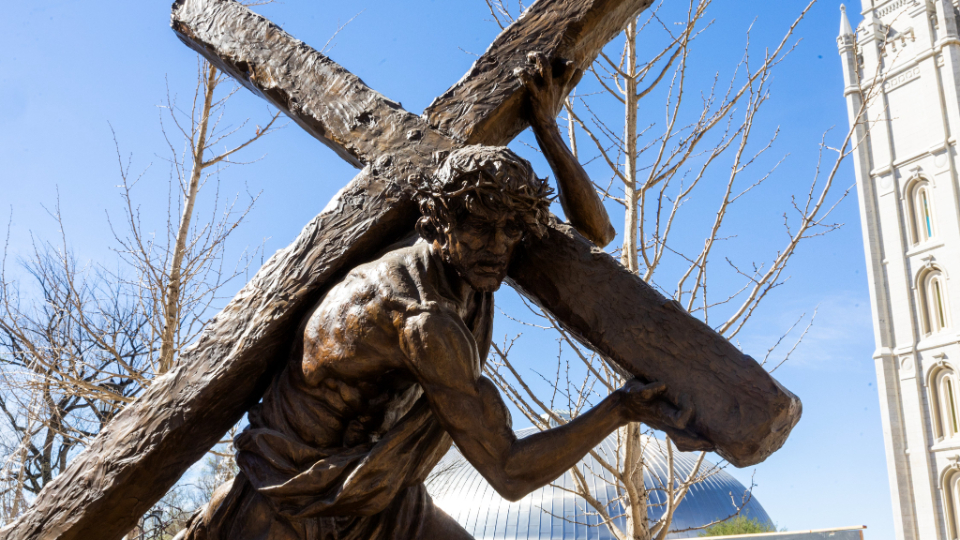
I welcome and celebrate this greater focus on the cross. For a long time, when I was a Latter-day Saint, we avoided both images of and emphasis on the cross. I remember people telling me that the cross was a symbol of death, not of life. I even remember people making the fallacious analogy that if Jesus had been shot by a gun, we wouldn’t use that as a symbol either.
I celebrate that Latter-day Saints are now more open to the image of the cross, because I believe the cross has power. But I also worry that the choice to show only Jesus carrying the cross—and not him crucified— can obscure the message and power of the cross.
Showing only the journey and not the destination can obscure three vital aspects of the point of the cross that I have been meditating on this Good Friday and Holy Week.
What the Cross Reveals About Us
First, it shows us humanity—what we can do, what we are capable of, our rejection of God.
The cross represents the worst, most public, most humiliating, most degrading punishment mankind could inflict—and that this punishment was inflicted on our God and Savior, Jesus Christ. It reminds us that we rejected and scorned and punished the one innocent person who ever walked among us. That we condemned him and called him guilty. That we lifted him up for mockery, stripped him of his clothes and his dignity, and drove nails into his hands and feet and side (Matthew 27:27–31, 35; Mark 15:16–24; Luke 23:33–34; John 19:1–3, 18, 23–24, 34).
The cross reminds us that we did that. That we rejected the light when it came among us and chose darkness rather than light.
That’s the point of the cross.
And if we could inflict such punishment on one who is truly innocent, that should make us fear and tremble before a holy God, when we, in fact, are guilty.
It reminds us that we truly deserve the punishment that Jesus received in our place.
The Cross as Judgment
Second, it is a representation—a symbol—of the wrath of God for sin. It’s not something private that we can look away from. It’s not something we merely experience inwardly.
The cross is a public, outward manifestation of judgment that gives us a taste of God’s wrath against sin. Isaiah says, “he was pierced for our transgressions; he was crushed for our iniquities… and the LORD has laid on him the iniquity of us all” (Isaiah 53:5–6). Paul says that God put Christ forward “as a propitiation by his blood” (Romans 3:25). The cross reflects for us the judgment that we richly deserve, poured out for all the world to see.
The Cross as Crossroads of Decision
Third, the cross is a crossroads for us. It is a place of decision where we are not meant to be able to look away.
I think this is best represented by the story of Simon of Cyrene, who was forced to help Jesus carry the cross (Matthew 27:32; Mark 15:21; Luke 23:26). He was going about his day, probably imagining that he was going to celebrate the Passover, go to the temple, and carry on with his usual life. And then Jesus was thrust upon him, and he was forced into contact with the cold calculus of the cross—with the wrath, the punishment, the innocent condemned and suffering.
And he was made—forced—to come under the cross and decide: Is this man the Christ?
As he was forced to walk with Jesus, we later learn that his heart did become that of a believer, and that his children were Christians in the generations that followed. Mark identifies him as “the father of Alexander and Rufus” (Mark 15:21), and Paul later greets Rufus in Romans 16:13.
This moment transformed his life.
This was not just a quiet, contemplative moment in the garden, surrounded by his closest followers.
The cross is the public working out of salvation in front of the whole world. And we are forced to take a side.
Why the Cross Has Power
It is not a coincidence that the authors of the New Testament refer repeatedly to the cross. Paul says to the Corinthians, “I decided to know nothing among you except Jesus Christ and him crucified” (1 Corinthians 2:2). To the Galatians, he says, “It was before your eyes that Jesus Christ was publicly portrayed as crucified” (Galatians 3:1). To the Colossian saints, he says that God has forgiven us all our trespasses “by canceling the record of debt that stood against us with its legal demands. This he set aside, nailing it to the cross” (Colossians 2:13–14).
These apostles turned repeatedly to the cross as the symbol of the triumph and victory of Christ, and I am so grateful whenever people move toward displaying and emphasizing the cross, because I do not believe we can ever look at, think about, or talk about the cross too much.
As Paul even says in Galatians 6:14, “Far be it from me to boast except in the cross of our Lord Jesus Christ.” Amen.
The Danger of Stopping Short
But that’s why I am concerned with the Temple Square sculpture’s focus on the walk to crucifixion rather than on the crucifixion itself.
I think there is a danger in focusing on the process, the obedience, the effort of Jesus, while missing the finality of the cross—missing the fact that our sins were nailed to it, that Christ declared, “It is finished” on the cross (John 19:30).
Yes, we should celebrate Christ’s devotion, his dedication, his obedience, his perseverance amidst unspeakable physical agony and spiritual torture. Hebrews tells us that “although he was a son, he learned obedience through what he suffered.” (Hebrews 5:8).
But we should not end there.
He Bore What We Could Not
We should remember the purpose of the cross: Christ being lifted up to expose us, to become a curse for us, and to heal us.
Jesus himself says, “And I, when I am lifted up from the earth, will draw all people to myself” (John 12:32). And just as the bronze serpent was lifted up in the wilderness so that the dying could look and live, “so must the Son of Man be lifted up, that whoever believes in him may have eternal life” (John 3:14–15).
And as Paul says in Galatians 3:13, “Christ redeemed us from the curse of the law by becoming a curse for us—for it is written, ‘Cursed is everyone who is hanged on a tree’” (cf. Deuteronomy 21:23).
It’s not inappropriate to learn from Christ’s diligence and obedience in his walk to the cross. But we should not focus on the walk to Golgotha as something to emulate—something we need to pick up and do for ourselves.
Instead, we should realize that Jesus made that walk because we couldn’t. He bore the cross because we couldn’t. He suffered for us, in our place. “He himself bore our sins in his body on the tree” (1 Peter 2:24).
And our response should be to fall down at the foot of the cross—to bring to the cross only our sins—the sins that nailed him there, the sins that brought him there.
The cross represents, ultimately, God coming down into his creation, being rejected, and dying in order to lift us up with him if we believe in him—that as we die with Christ, we are raised to new life in him. As Paul says, “I have been crucified with Christ. It is no longer I who live, but Christ who lives in me” (Galatians 2:20). And again: “We were buried therefore with him by baptism into death, in order that, just as Christ was raised from the dead… we too might walk in newness of life” (Romans 6:4).
That is the point of the cross.
Not something we have to bear, but something Christ bore willingly for us.
So I hope that my Latter-day Saint friends—and everyone else reflecting on Good Friday and the Atonement—will keep looking to Jesus nailed on the cross, and not look away.