

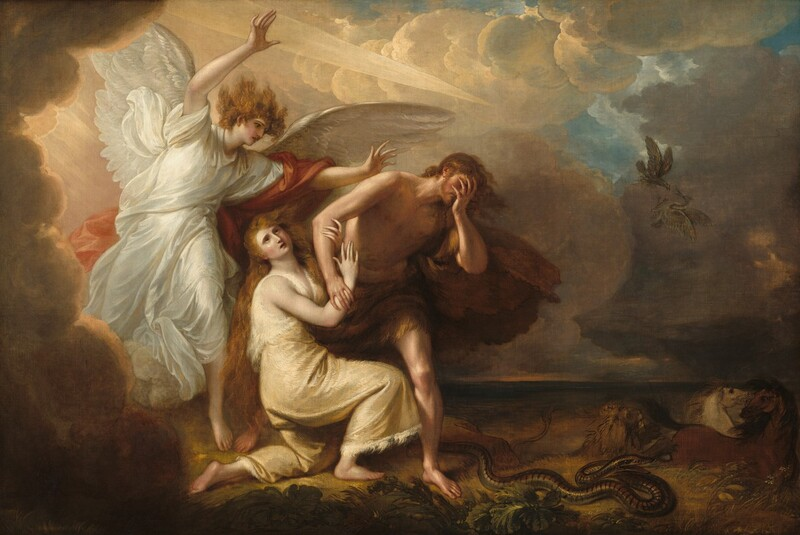
(The Expulsion of Adam and Eve from Paradise by Benjamin West)
The Fall of mankind is one of the most pivotal events in Biblical history. How we interpret that event shapes everything: how we see the world, understand sin, grasp the purpose of the atonement, and recognize our need for reconciliation with God.
Latter-Day Saints view the Fall not just as a necessary step, but even as an act of moral bravery on the part of Adam and Eve. LDS President Dallin H. Oaks went so far as to say that, “we celebrate Eve’s act and honor her wisdom and courage in the great episode called the Fall.”
Several elements of the LDS view of the Fall include:
- It is a necessary step in mankind’s moral development
- It is necessary for the existence and propagation of the human race
- The Fall is framed as a transgression rather than sin
- God allegedly gave Adam and Eve conflicting commandments
- Adam and Eve are portrayed as brave and courageous for eating the fruit
But is this consistent with what the Bible says? The biblical account never portrays the Fall positively. Instead, it describes a cataclysmic event that introduced sin and death into the world and alienated humanity from God.
Many New Testament passages refer to the Fall, but one stands out because it sharply contrasts the LDS idea of a “fortunate” Fall. In 2 Corinthians 11:3, Paul warns the Corinthian saints about the risk of spiritual deception: “I am afraid that as the serpent deceived Eve by his cunning, your thoughts will be led astray from a sincere and pure devotion to Christ.” Paul does not present the Fall as necessary or positive. He analogizes it to serious deception and even apostasy, framing Eve’s action as rebellion against God—the same kind of rebellion threatening the Corinthian church.
Paul emphasizes that Satan deceived Eve by his cunning, enticing her to look away from God. She was drawn to the serpent’s lies: 1) that God’s commandments were restrictive and burdensome; 2) that the fruit would be pleasing and desirable; and 3) that disobedience would grant her moral autonomy, the ability to “be as gods, knowing good and evil” (Gen 3:5). This temptation was not neutral or constructive—it was designed to lead her away from God.
Some LDS interpretations point to Genesis 3:22, claiming that God is ratifying humanity’s progress toward “knowing good and evil.” But the text is ironic: God is observing that humanity has chosen to determine good and evil apart from Him. The tragic reality is that, in insisting on being its own god, humanity has achieved autonomy—but at the cost of suffering, death, and separation from God.
The consequences are severe. Eve sought autonomy, but in a world without God, she will be subject to her husband. Adam sought freedom and pleasure, but he will toil the ground under a hostile curse. Their rebellion mirrors the rebellion in every human heart. We are alienated from God both because of Adam’s sin and our own choices.
Yet even in this dark moment, there is hope. In Genesis 3:15, God promises a seed who will be struck by the serpent but will ultimately crush its head. That seed and serpent crusher is Jesus Christ. Unlike Adam and Eve, He lived perfectly obedient to His Father, resisted temptation in the wilderness, and never sought His own glory. Because of Him, we too can be reconciled to God despite the Fall.
Seeing Adam and Eve as heroes distracts from the true hero of Scripture: Jesus Christ, who redeems us from the tragic consequences of our rebellion. To glorify Adam and Eve in their disobedience is to underestimate the wickedness in our own hearts and to look inward for reconciliation with God through moral effort rather than upward to the cross of Calvary.