
When we think of Christmas, we imagine a silent night, not a battlefield. But in addition to bucolic fields and shepherds, perhaps one image that should come to mind when we imagine Christmas is the Battle of D-Day, when American (and other Allied) soldiers began to take Europe back from Nazi control.
(I know that other Christians have used this metaphor before, but I can’t remember where I first encountered it and therefore regrettably cannot give credit where it is due.)
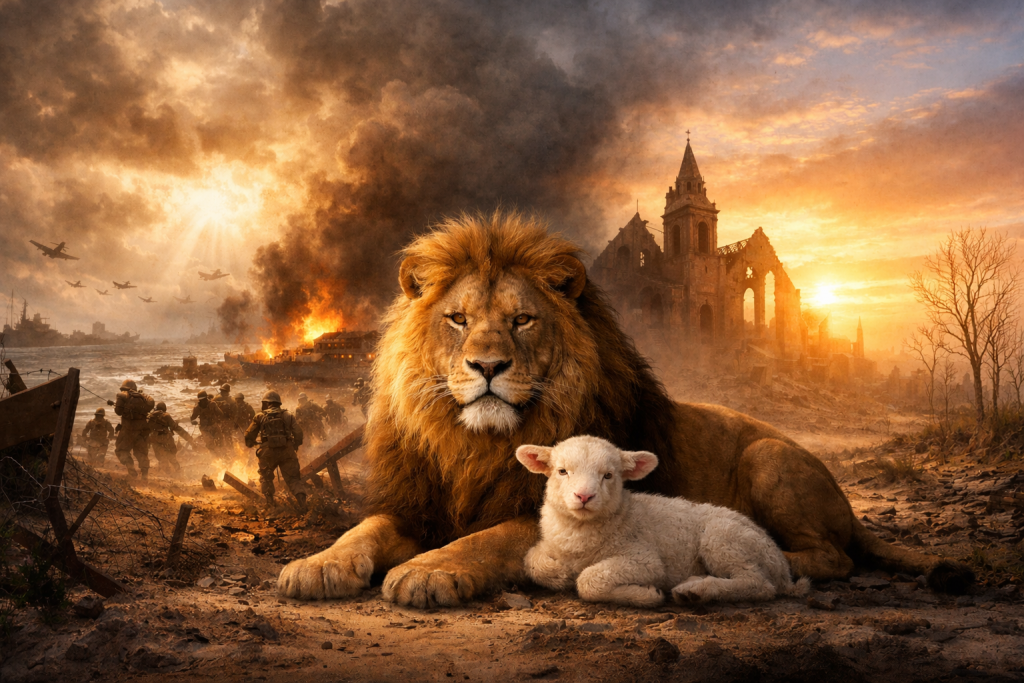
At the time of Christmas, the world was under the control of Satan, who had dominion over the hearts of human beings. Sin had warped human affections and turned us into collaborators in Satan’s rebellion against God. From the time of the Garden of Eden, God had permitted Satan’s malevolence.
But God promised that one day a serpent-crusher would be born who would crush the head of Satan (Genesis 3:15). Generations of Israelites looked forward with eager anticipation to that day.
On Christmas, the Savior of the world was born. God entered into our story. He came to show us that he is a God who fulfills his promises. He took on flesh to redeem us from the tyranny of our sinful flesh and to bring us back into right relationship with himself.
Christmas was the moment when everything changed. It was the moment when the kingdom of God smashed into the kingdoms of this world. It was the moment when it began to roll like a stone that would eventually fill the whole earth (Daniel 2).
There would be many battles to come. Satan would, for a moment, appear to triumph when Jesus hung on the cross. But in his resurrection, Jesus declared victory over death and sin. He established his Church and empowered Christians to spread his gospel to the ends of the earth. He bound the strong man (Matthew 12:29) and plundered his house. Never again would Satan be ascendant.
At Christmastime, all of this was yet to come. And yet Christmas was the start of Christ’s victory march. It was the inauguration of his kingdom. The decisive battle was already won the moment the King entered his world.
I thought about all of this when I watched the recent debate on the Great Apostasy between Jacob Hansen and Joe Heschmeyer.
Catholics, Orthodox, and Protestants all understand the nature of Christ’s church and kingdom differently. But we fundamentally agree on this point: the beachhead Christ established would never be taken back by Satan. Satan would not prevail against the kingdom of Christ. There would be no retreat back across the Atlantic. Christ came once and for all to liberate his people, and he would be victorious.
The Latter-day Saint narrative is very different. Christ came and attempted to establish his church, but the forces of Satan were too strong. The apostles were killed and did not pass along their authority. The institution Christ established floundered and fell apart within a single generation. The church and the light of Christ were snuffed out. The iron curtain of Satan’s kingdom descended upon the world for more than 1,500 years. Jesus’s kingdom was in retreat. The defeat was so complete that Jesus needed to call a prophet and establish a new, latter-day covenant. Where Jesus failed the first time, this time he would succeed in establishing his church.
But that is not the biblical story.
Jesus came to conquer the evil one. He promised that his kingdom would not be defeated. He promised liberation to the captives and light to those in darkness. For Christians, Christmas represents this promise. While we still live in enemy-occupied territory, the King is on the march. Nothing will stop him. And he will not stop until the kingdoms of this world are under his rule.